New Hope for the Jerusalem Mill

Linton Research Fund, Inc., HOME PAGE Guest Book LINTON Gallery BIRD Gallery Blog BIRD Family Tree LINTON Family Tree Who is having a Birthday or a Anniversary today? BIRD Chronicles LINTON Chronicles GAY Family Tree CRONK Family Tree The Virginia LINTON Family Tree HULING Family Tree Clara Myrtle GRAY-Sadler Bird (1900-1988) Family Tree ROSS Family Tree CROASDALE Family Tree STONESTREET Family Tree KOCHER Family Tree HAYHURST Family Tree HIRST Family Tree FARIS Family Tree RADCLIFFE Family Tree CARROLL Family Tree ROBESON Family Tree

LINTON & BIRD CHRONICLES, Volume V, Issue 2, Summer © 2010, ISSN 1941-3521

NEW HOPE FOR THE JERUSALEM MILL page four

New life for millwright, Isaiah Linton, and, miller, David Lee’s Jerusalem Mill may be just around the corner! We hope so! If you would like to help in the fight to save the Jerusalem Mill, please write to the Friends of Jerusalem Mill, 12514 Jerusalem Road, Kingsville, Maryland 21087. If you would like to apply for annual individual membership please send ten dollars for a Friend, twenty-five dollars for Supporting, fifty dollars for Sustaining and one hundred dollars for Lifetime membership.

Jerusalem Mill, MD., Part II

NEW HOPE FOR THE JERUSALEM MILL

By Terry L. Linton Regional Reporter

Old Mills News © ISSN 0276-3338

Publication of the Society for the Preservation of Old Mills Vol. XV, No 3, Whole Number 60, © Summer 1987 page 10

LINTON & BIRD CHRONICLES, Volume IV, Issue 3, Fall © 2009, ISSN 1941-3521

photos added in

LINTON & BIRD CHRONICLES, Volume V, Issue 2, Summer © 2010, ISSN 1941-3521

_________________  

Friends of Jerusalem Mill Silver Jubilee

By Harry Sanders & Chris Scovill © 2010

Gristmill Gazette © 2010

Jerusalem Mill Village New & Notes

Editor

Susan K. Wooden

Origins of Friends of Jerusalem Mill

Longtime members know the origins of Friends of Jerusalem Mill, but it is a tale worth retelling in this silver anniversary year.

Jerusalem Mill had a long, storied life from 1772 to 1961 when the last miller, Jack Bridges, died. The State bought the mill, the former blacksmith shop, and the building commonly referred to as the Gun Shop. These were among the first properties to be acquired in what became Gunpowder Falls State Park. Unfortunately, no use was made of these historic 18th century structures, so they sat vacant for nearly 25 years while falling into disrepair.

In 1985 their savior arrived in the unlikely person of a 12-year-old boy. Scott Sanders lived with his schoolteacher parents, Harry and Carol, and sister, Kristen, just up the road from the mill, so he had almost daily opportunity to witness its decline. With the clear vision of youth, Scott asked his father why nothing was being done to save the mill. From that defining moment Harry undertook to form the Friends of Jerusalem Mill.

Initially there was a small committee of Harry Sanders, Latham Martin, Mary Frances Shepherd, Frances Bell, Steve Wortek, and Glenn Porter. Christopher Weeks and Mary Helen Cadwalader wrote the nomination for placement of the entire village on the National Register of Historic Places. Ken Holt filed incorporation papers and pursued designation as a 501(c)(3) nonprofit organization, and thus Friends of Jerusalem Mill was formally created.

The challenges of navigating through government channels were daunting, but Harry persisted. The late Senator Bill Amos was persuaded to champion our cause, and Rick Barton, Superintendent of State Parks, was a sympathetic ear within the Department of Natural Resources. As evidence of our commitment, Friends of Jerusalem Mill, undertook restoration of the Gun Shop with Latham Martin, Butch Profili, Bob Langley, Guy Akob, and Walter Mast performing the work.

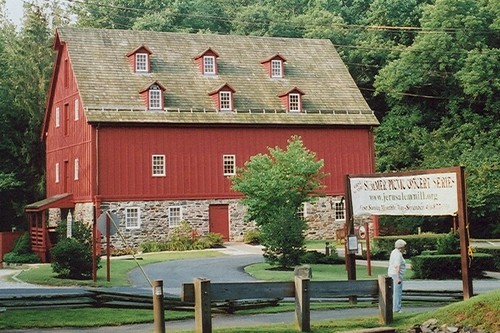
The completed project convinced any doubters of our sincerity. The decision was made that the mill would become the headquarters for Gunpowder Falls State Park. Unfortunately the original structure had deteriorated to the point where it made economic sense to take the old mill down and then build a replica incorporating some original components. While this work was being done under a state contract, Friends of Jerusalem Mill, began restoring the blacksmith shop, with sweat equity and little money.

The mill was dedicated in 1995. Starting with a few artifacts, the museum and visitor center opened with Chris Scovill as curator and Bill McCartin in charge of fabricating displays. Terry Crawford was instrumental in starting costumed interpretation in the Gun Shop, as well as the annual Colonial Craftsmen Weekend. With some initial trepidation, we undertook our summer concert series organized by Leigh Ullrich.

With Program Open Space funds, the State acquired the privately owned structures. Jack Shagena was recruited to oversee reconversion of the general store with a crew comprising Mary Holt, Hank Bullwinkel, and Joan Scovill.

We sincerely thank everyone involved over the years whose names we did not mention!

Harry Sanders & Chris Scovill © 2010

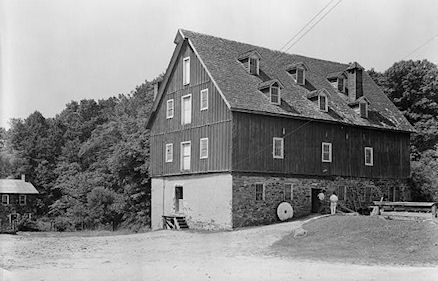
Jerusalem Mill in 1936

As the Mill Wheel Turns

by Chris Scovill © 2010

Gristmill Gazette © 2010

Jerusalem Mill Village New & Notes

Editor

Susan K. Wooden

In 1769, millwright Isaiah Linton engaged David Lee, a miller from Bucks County, Pennsylvania, in a partnership to operate a gristmill that Linton intended to build on a tract of land called Jerusalem, along the Little Falls of the Gunpowder.

The gristmill was completed in 1772. One of numerous mills in this area (perhaps as many as 80 or 90 in Harford County over the course of time), it was distinguished from other mills by its technology and longevity. Typically, mills have an external water wheel, but here there were two wheels in the basement. The advantage of this arrangement was to address the vulnerability of external wheels to freezing up in the winter, which required the miller to either break the ice off the wheel or wait for a thaw to resume operations.

The mill was powered by a race, a hand dug canal that transported water from a small dam approximately one-half mile upriver. Water flowed down the race, under the road, and then entered the building through an opening below the second window from the west end of the building to pass through the basement and power the two internal wheels. A picture on the wall in the Visitor Center shows the race in front of the mill around 1930.

The original mill is listed in the 1814 tax assessment as "grist mill 2-story 60x32 ft". Known as Lee's Merchant Mill until the 1870s, the mill was one of the important early mills in Harford County, and one of the largest merchant grist mills in Maryland.

The business eventually evolved to a combination of services for the local farming community. The Lees sold the mill and race in 1886. There was a succession of owners and millers thereafter. The last miller was Jack Bridges, who found creative ways to compensate for the decline of flour milling. When Jack died in 1961, the State bought the mill and adjacent properties for the Gunpowder Falls State Park.

Chris Scovill © 2010

______________________


Excerpt from Isaiah LINTON (1739-1775) Master Millwright of Bucks County Pennsylvania and Baltimore & Harford Counties Maryland

On August 13, 1772, Isaiah Linton and David Lee again entered into another agreement, "said David Lee, miller, living near Joppa, shall enter into the said premises of said Lee's Merchant Mill, and set forth into the milling, grinding, and manufacturing business". Also, David Lee, "is agreed to pay a sum of one-half the said profits, emolument, and advantages, arising from said mill, for a term of four years, to said Isaiah Linton, millwright". 1

On September 7, 1772, Isaiah and Sarah Linton sold Lee's Merchant Mill and the Upper Jericho Saw Mill to David Lee as part of Bonds Water Mills, containing a 50 acre mill seat, mill dam, and saw mill. David Lee paid only five shillings for this valuable merchant mill and seat. This sum was just enough to cover the court recording fee. 2 Isaiah's forth mill, known as Lee's Merchant Mill and the Jerusalem Merchant Mill, stayed in continuous operation, for 188 years, until 1961, and is standing today, some 217 years later. The Jerusalem Merchant Mill is now under the care of The Friends of Jerusalem Mill, and is listed on the National Register of Historic Places.